How to Mulch Around Trees and Fix a Mulch Volcano
Mulch helps trees until it's piled against the trunk. Here's how wide and deep to go, and how to safely undo a volcano that's already there.
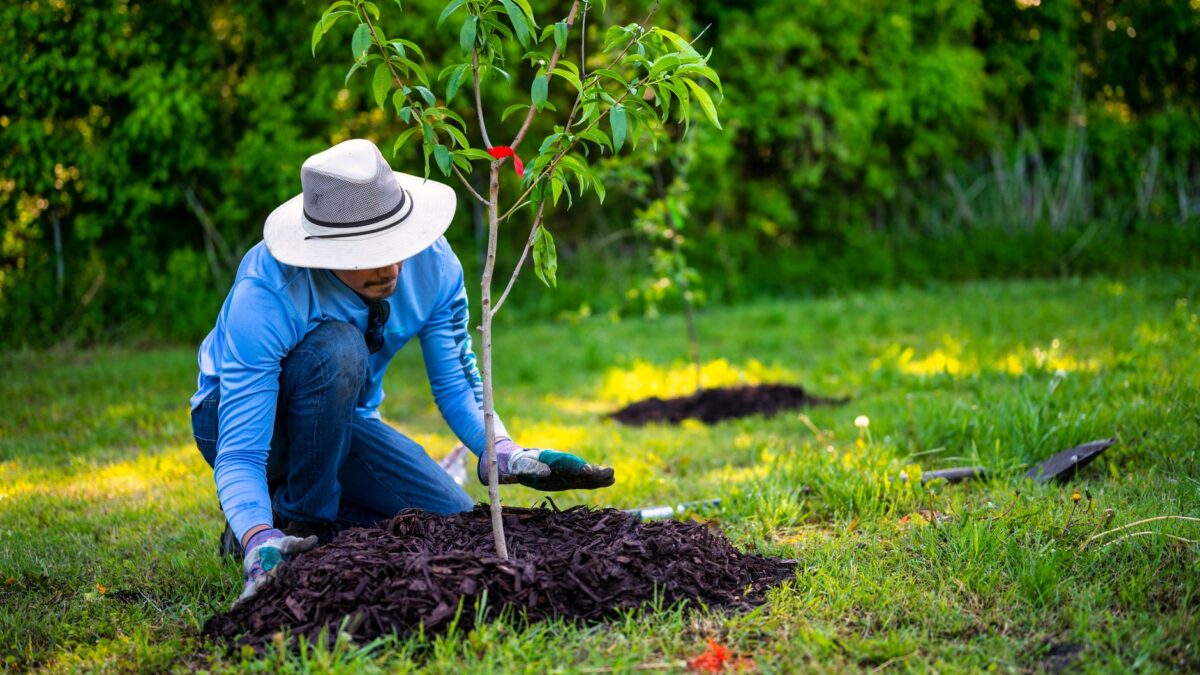
Mulch a tree in a wide, flat ring 2 to 4 inches deep, starting at least 3 inches from the root flare, the point where the trunk widens into the roots. If yours is a tall cone against the trunk, called a mulch volcano, rake the excess away until the flare shows, then spread it thinly. It takes minutes, and it’s one of the most useful things you can do for a landscape tree.
Why mulch helps, and why volcanoes hurt
Good mulch holds soil moisture, moderates soil temperature, reduces compaction and weeds, and keeps mowers and trimmers away from the trunk. A mound does the opposite of what you want. According to University of Vermont Extension:
- Mulch against the trunk traps moisture, which encourages decay and gives insects and disease a way in.
- Covering the root flare cuts off oxygen to the roots and weakens the tree’s stability.
- Mulch deeper than 4 inches can cause roots to grow out of the trunk. These can circle and girdle the tree, disrupting water and nutrient movement.
- Deep mounds give voles shelter and easy access to chew the bark.
The damage is slow. A tree can sit in a volcano for years before dieback shows up, and by then it may look like something else. See why a tree dies from the top down if yours is already struggling.
How to mulch a tree properly
- Find the root flare. Look for where the trunk starts to widen at the base. If the trunk goes into the ground like a fence post, the flare is buried, so uncover it before adding anything.
- Clear the area. Remove grass and weeds from the planned ring by hand or with a shallow edging tool. Dig as little as possible, since many roots are close to the surface.
- Check what’s already there. Old bark mulch breaks down slowly and may still be deep enough. Measure with a ruler or trowel before you add more.
- Mark the ring. Go as wide as you reasonably can. UVM recommends extending to the drip zone, the area under the outer edge of the canopy.
- Spread 2 to 4 inches. Keep the layer level, not domed. Use the lower end on heavy, wet soils.
- Pull it back from the trunk. Leave at least 3 inches of bare space around the flare. It should look like a donut, not a cone.
- Water it in lightly on a new planting, then water the soil beneath as the tree needs it.
For mature trees, many arborists use the 3-3-3 method: at least 3 inches from the trunk, no more than 3 inches deep, and about 3 feet across. Treat that width as a minimum. Wider is better.
How to fix a mulch volcano
- Pick a dry day. Any time the ground isn’t frozen is fine, and late fall works well.
- Pull mulch away from the trunk with your hands or a soft rake. Avoid sharp shovels and power tools near the bark and surface roots.
- Keep going until you see the flare. Spread the excess out into a ring, or take it elsewhere in the garden.
- Check the bark. Dark, wet or soft patches suggest decay. Allow them to dry, and don’t apply wound paint.
- Look for roots from the trunk. Fine roots growing in the old mulch will dry out now, which is expected. Thick roots circling the trunk are another matter, so leave them and see below.
- Level the ring to 2 to 4 inches. Add fresh mulch only if you need it to reach that depth.
When to bring in an arborist
If the volcano has been there for many years, take it down gradually and carefully. When the flare is buried under compacted soil or mulch, or you find thick girdling roots, an arborist can do a root collar excavation, clearing the soil from around the base without damaging the bark. Don’t cut large roots yourself.
Do and don’t
| Do | Don’t |
|---|---|
| Keep the root flare visible | Pile mulch against the trunk |
| Make a wide, even ring | Build a tall cone or ring of stones around the base |
| Stay within 2 to 4 inches | Add a new layer every year out of habit |
| Measure existing mulch before topping up | Top up mulch that’s still deep enough |
| Use coarse organic mulch | Lay plastic sheeting under mulch, which blocks air and water |
| Rake old mulch to loosen a crusted surface | Till or dig deeply in the root zone |
| Remove twine, burlap and wire on new plantings as far as you can | Bury the root ball deeper than the flare |
Which mulch to use
Wood chips, shredded bark and leaf mold all work. Coarse organic mulches let air and water through and break down slowly, feeding the soil. Our hardwood vs pine bark vs straw comparison answers common questions about soil pH, nitrogen and termites.
Very fine mulch can mat into a crust that sheds water. Rake it loose once or twice a year. Keep any mulch at least a little farther away from walls and foundations if termites are a local concern.
Winter and mulch
Mulch against the bark gives rodents cover right when food gets scarce. Pull it well back before snow arrives, and fit guards on young trunks using our guide to protecting trees from rabbits and voles. Your winter mulch timing for beds and borders is different, as explained in when to apply winter mulch.
How often to refresh
There’s no fixed schedule. Check the depth each spring. If you still have 2 inches or more, just loosen the surface. Top up when it’s thinned, keeping the total under 4 inches. Commercial crews often mulch every year for looks, which is how many volcanoes build up in the first place.
Also keep the soil level steady. University of Maryland Extension advises against adding or removing more than 3 inches of soil or mulch within the root zone, as that changes how oxygen reaches the roots.
Bottom line
Think wide and flat, not tall and narrow. Keep mulch 2 to 4 inches deep, at least 3 inches from the root flare, and out toward the drip line where you can. If you already have a volcano, rake it back today, and call an arborist if you find girdling roots or a deeply buried flare.
FAQ
How far from the tree trunk should mulch be?
At least 3 inches from the root flare. Mulch should never touch the trunk.
How deep should mulch be around a tree?
Between 2 and 4 inches. Deeper than 4 inches can cause roots to grow into the mulch and from the trunk.
Will removing a mulch volcano hurt the tree?
Pulling the mulch away is safe when done gently. Roots that have grown in the mound may dry out, so water during dry spells afterward, and call an arborist for old, thick buildups.
Can I put new mulch on top of old mulch?
Only if the total stays within 4 inches. Measure first, and loosen the old layer rather than burying it.