Hardneck vs Softneck Garlic: Which Should You Grow?
The right garlic depends on your winters. Here is how hardneck and softneck compare on hardiness, scapes, storage and cloves, plus why supermarket bulbs can let you down.
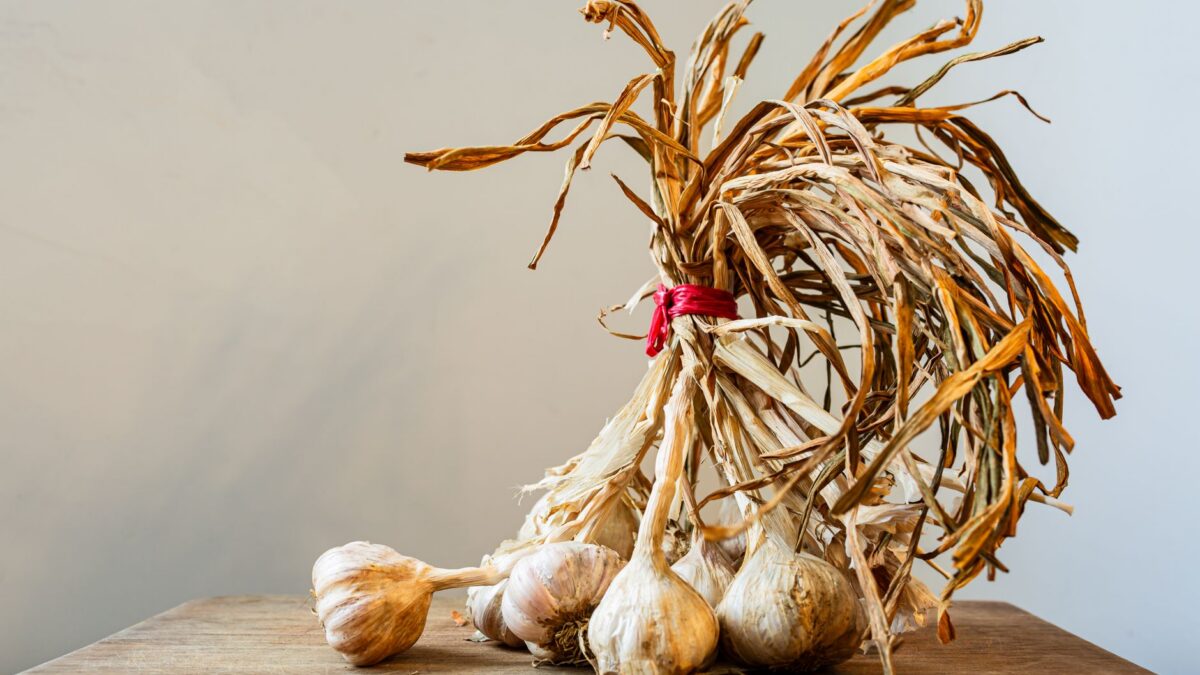
Grow hardneck garlic if you have cold winters and want big, easy-to-peel cloves plus edible scapes. Grow softneck garlic if your winters are mild, or if you want bulbs that store longest and can be braided. In the middle zones, both can work, so many gardeners plant some of each. Whichever you pick, buy seed garlic rather than planting supermarket bulbs.
Hardneck vs softneck at a glance
| Trait | Hardneck | Softneck |
|---|---|---|
| Best climate | Cold winters; generally hardier | Mild winters; also grown in many colder areas with mulch |
| Flower stalk | Yes, a woody stalk topped by a scape | No stalk, so the neck stays soft |
| Cloves | Fewer, larger, in a ring around the stalk | More cloves, many small, in layers |
| Peeling | Usually easier | Tighter skins |
| Storage | About 3 to 6 months, depending on type | About 6 to 8 months; some types 10 to 12 |
| Braiding | No | Yes |
| Common groups | Rocambole, Porcelain, Purple Stripe | Artichoke, Silverskin |
| Example varieties | ‘Music’, ‘German Extra Hardy’, ‘Russian Red’ | ‘Inchelium Red’, ‘California Early’, ‘Silverskin’ |
Which type suits your winters?
Garlic needs cool weather to form cloves, but hardneck types depend on it most. As a loose guide:
- Zones 3–5: start with hardneck. University of New Hampshire Extension says hardnecks are generally hardier and better able to handle long, cold winters.
- Zones 6–7: try both. Local varieties and growers will tell you what does well nearby.
- Zones 8–10: go with softneck. University of Georgia Extension recommends Artichoke and Silverskin softnecks because they suit Georgia better than hardnecks, and the University of Florida suggests softnecks for Florida gardens too.
Timing and depth depend on your zone, and our guide to when to plant garlic breaks it down. In cold zones, either type benefits from a layer of winter mulch.
Scapes: a bonus crop from hardnecks
In early summer, hardnecks send up a curling stem called a scape. It’s edible, with a mild garlic flavor, and it can be chopped into stir-fries or blended into pesto.
Most growers cut scapes once they curl, and New Hampshire’s extension says this lets bulbs grow larger. Other sources say the research isn’t conclusive. There’s also some circumstantial evidence that leaving scapes on until they turn woody may improve storage life. If you’re growing for eating, snipping them is an easy win. Softnecks don’t produce scapes, which saves a job but gives you no second harvest.
Storage life
This is where softnecks earn their keep. Rutgers and other extension services describe the differences by group:
- Hardneck: many keep about 3 to 4 months. Some Porcelain and Purple Stripe types may reach six months in good conditions.
- Softneck: typical softnecks last 6 to 8 months at room temperature. Artichoke and Silverskin types can go 10 to 12 months.
A practical plan is to eat hardneck first, through fall and early winter, and save softneck for late winter and spring.
Storage starts at harvest, and both types are handled the same way. Lift bulbs when about a third to a half of the leaves have yellowed or died back, because leaving them in the ground too long can cost you storage life or rot the bulbs.
Cure bulbs in a dry, airy place for a few weeks, then store them somewhere cool, dark and well ventilated. Skip the refrigerator for whole bulbs. North Dakota State University notes that temperatures near 40°F can trigger sprouting.
Why grocery garlic can disappoint
Planting a supermarket bulb is tempting, but it has a few problems:
- It may not suit your climate. Grocery garlic is usually softneck, and University of New Hampshire Extension notes those cultivars aren’t necessarily adapted to local conditions. A bulb grown for mild winters may struggle in zone 4.
- It may have been treated. Some supermarket garlic is treated with a sprout inhibitor to extend shelf life, which can reduce sprouting.
- You don’t know what you’re getting. Grocery bulbs rarely list a variety or origin, so you can’t repeat a success.
- It may carry disease. Seed garlic growers select for clean stock. Planting an unknown bulb risks bringing problems into your soil, where they can persist.
A small order of seed garlic or bulbs from a local grower costs more per clove, but you can save your best bulbs and replant them each year, so you only pay once. Use rotation to keep disease down, as our guide to crop rotation in a small garden explains.
What about flavor?
Flavor varies by variety, soil and season more than by neck type alone. Hardnecks are often described as having a more complex taste, but that’s a matter of opinion, so try a few and keep notes.
A note on pets
Garlic is toxic to dogs and cats. Keep bulbs, braids and scapes where pets can’t reach them.
Bottom line
Let your winters decide. Choose hardneck for cold zones, softneck for mild zones, and try both in between. If storage matters most, softneck wins. If you want big cloves and scapes, hardneck wins. Start with seed garlic from a reputable source, then save your best bulbs to replant.
FAQ
Can I grow hardneck garlic in the South?
It’s possible in cooler parts of the South, and University of Georgia notes hardnecks can be grown in the Southeast. Softneck types are usually the more reliable choice there.
Can softneck garlic survive a cold winter?
Often yes, especially with mulch. Hardnecks are still the safer choice in zones 3 and 4.
Is elephant garlic hardneck or softneck?
Neither. Elephant garlic is more closely related to leeks than to true garlic, and it has a milder taste.
Which garlic is best for braiding?
Softneck. Hardnecks have a rigid central stalk that won’t bend into a braid.