Spotted Lanternflies Reach Stockbridge as Berkshire Infestations Grow
Two adult spotted lanternflies turned up at Berkshire Botanical Garden. What it means for gardeners and how to destroy egg masses this fall.

Two adult spotted lanternflies have been found at Berkshire Botanical Garden in Stockbridge, Massachusetts, the latest sign that the invasive insect is settling into Berkshire County. The garden’s director of horticulture, Eric Ruquist, reported the find to the Massachusetts Department of Agricultural Resources (MDAR), and the Berkshire Environmental Action Team (BEAT) flagged it to residents in a Nov. 1 statement, The Berkshire Eagle reported.
No infestation has been confirmed in Stockbridge. But MDAR has already recorded infestations in four Berkshire communities since 2025, and lanternflies have been seen in at least five towns in the county.
Where have spotted lanternflies been found in the Berkshires?
Ruquist described the two insects in the Oct. 16 edition of UMass Extension’s Landscape Message newsletter and said the sightings had been passed to MDAR for follow-up. MDAR counts an area as infested only when lanternflies are found on trees feeding, mating and laying eggs.
By that standard, the agency flagged infestations in Mount Washington, Egremont and Great Barrington in 2025, and in New Marlborough this year. Last year the insect was also spotted for the first time in Northampton and Westfield, before it reached the Berkshires.
Why does it matter for home gardeners?
Spotted lanternflies (Lycorma delicatula) suck sap from a wide range of plants, including basil, peppers and ornamentals, and they are especially hard on grapevines. As they feed, they excrete a sugary liquid called honeydew, which lets mold grow on leaves and surfaces below.
According to UMass, heavy feeding on grapes can cut photosynthesis and drain the reserves vines store in their roots and canes. Weakened vines then produce fruit with less sugar, ripen later and give smaller harvests the following season. Anyone growing grapes in western Massachusetts has reason to watch closely.
How did the insect get here?
The species is native to China, India and Vietnam. It was first found in the United States in Berks County, Pennsylvania, in 2014 and has been spreading in Massachusetts since 2021. UMass reports it had reached 19 states and the District of Columbia as of September, and more than 170 Massachusetts communities as of Oct. 14.
People move it more than it moves itself. Cornell notes that adults fly into open car windows, picking bins and trucks being loaded, and that eggs can be laid on almost any outdoor surface.
What should I look for this fall and winter?
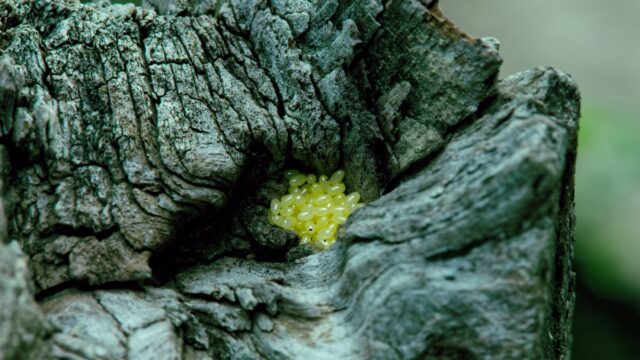
Adults become harder to spot as the weather cools, but their eggs stay behind. Lanternflies usually mate in August and lay eggs from September through November, and the egg masses are the only life stage that survives a Massachusetts winter. UMass says one female can lay two to three egg masses a year, each holding about 30 to 50 eggs.
BEAT advises checking tree trunks, stones, cars and outdoor furniture for flat, gray patches. A mass is roughly 1 inch long.
What should I do if I find lanternflies or eggs?
- Report the sighting: take a photo, note where you saw it and submit it to MDAR through mass.gov/spotted-lanternfly, as BEAT recommends.
- Destroy egg masses: the U.S. Department of Agriculture suggests smashing them and scraping them into a zippered plastic bag with rubbing alcohol or hand sanitizer, then sealing the bag and putting it in the trash.
- Check your vehicle, trailers and outdoor gear before driving out of an area where the insect is known to live.
BEAT’s request to residents was simple: “If you spot one, don’t keep it to yourself.”
Source: The Berkshire Eagle