When to Prune Hydrangeas: A Calendar by Hydrangea Type
The right month depends on whether your hydrangea flowers on old wood or new wood. Here's how to tell, when to cut each type, and what a mistimed cut costs.
Prune bigleaf, mountain and oakleaf hydrangeas right after the flowers fade in summer, and prune panicle and smooth hydrangeas in late winter or early spring, before new growth starts. The split exists because the first group blooms on old wood and the second on new wood. If you’re not sure which you have, skip the cutting this winter, since doing nothing rarely costs you flowers.
Old wood and new wood in plain English
Old wood is any stem that was already there when the plant broke dormancy in spring. Hydrangeas that bloom on old wood form their flower buds in late summer and fall, then carry them through winter on bare stems. Cut those stems in fall or spring and you cut off next summer’s flowers.
New wood is growth made in the current season. Hydrangeas that bloom on new wood have no flower buds on their stems in winter, so late-winter pruning costs nothing.
A third group, called reblooming or remontant hydrangeas, forms buds on both. The old-wood buds open first, and new-wood flowers can follow into summer.
Pruning calendar by hydrangea type
| Type | Blooms on | When to prune | How much |
|---|---|---|---|
| Bigleaf (H. macrophylla), traditional | Old wood | Right after flowers fade; NC State Extension says before August 1 | Clemson advises removing no more than a third of total growth |
| Mountain (H. serrata) | Old wood | Right after flowers fade | Light shaping; treat like bigleaf |
| Oakleaf (H. quercifolia) | Old wood | Right after flowering; winter-damaged stems in early spring | Light; leave plenty of stem length |
| Climbing (H. anomala petiolaris) | Old wood | Right after flowering, only if needed | Not routinely pruned |
| Reblooming bigleaf | Old and new wood | After blooms fade; in late winter only if a hard freeze has already killed the buds | Light; cuts can delay the next flush |
| Panicle (H. paniculata) | New wood | Late winter or early spring, while dormant | Sources differ, see below |
| Smooth (H. arborescens) | New wood | Late winter, just before new growth | Can go down to 6–12 inches above ground |
Exact dates depend on your USDA zone. Late winter arrives weeks earlier in the South than in the North, so go by the plant’s dormancy and your local spring rather than a fixed date.
A year at a glance
| Season | Old-wood types | New-wood types |
|---|---|---|
| Late winter | Leave alone | Main pruning time |
| Spring | Once buds swell, remove only dead or winter-killed stems | Finish before leaves appear; remove weak stems |
| Early to midsummer | Main pruning as soon as flowers fade | Nothing needed |
| Late summer | Stop; buds are forming | Nothing needed |
| Fall | Leave alone | Optional. Penn State Extension says smooth types can be cut any time from fall to spring |
How to tell which hydrangea you have
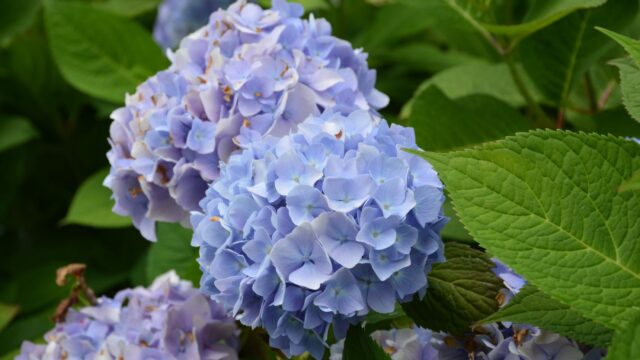
- Blue or purple flowers: University of Maryland Extension says only bigleaf and mountain hydrangeas, among commonly grown species, can produce them. Pink or white flowers can still be bigleaf.
- Oak-shaped leaves and peeling bark: oakleaf.
- Cone-shaped flower heads, white aging to pink, on a large shrub or small tree: panicle, also called peegee.
- Round white heads on a 3- to 5-foot mound with thinner leaves: smooth, the ‘Annabelle’ type.
- A vine clinging to a wall or tree: climbing hydrangea.
Still unsure? Wait until next summer, watch when it flowers and check the bloom shape against University of Maryland Extension’s hydrangea guide, which has photos of each type. If a plant is flowering already by early to midsummer on last year’s stems, treat it as old wood.
What a mistimed cut costs
- Old-wood type cut in fall, winter or spring: you lose some or all of next summer’s flowers. The plant itself is fine. If this has happened, our guide to hydrangeas that won’t bloom walks through the recovery.
- Old-wood type cut in late summer: buds are forming, so you remove them along with the stem.
- New-wood type cut in late spring or summer: flowers come later or are lost for the year, since you’ve removed stems about to form buds.
- Reblooming bigleaf cut in midsummer: University of Maryland Extension warns that this can interrupt or shorten the rebloom window.
How hard to cut panicle hydrangeas
Advice varies here. NC State Extension says panicle hydrangeas can be pruned severely in late winter or spring, and University of Maryland Extension says about 12 inches off the ground is possible but they can be left taller. UGA Extension advises pruning lightly and resisting a hard cutback. All are workable: a harder cut keeps the shrub smaller, while a lighter cut keeps more of its size and form. If you want a framework, cut back to a sturdy set of main stems at the height you like.
How to make the cuts
- Clean sharp tools first. A sharp bypass pruner makes a cleaner cut than a dull anvil tool on live stems.
- Remove dead, damaged and crossing stems first. Dead wood can come out at almost any time.
- Thin before you shorten. Removing whole stems at the base lets in air and light, which lowers the risk of leaf spot. Because you’re taking out entire stems, University of Maryland Extension says timing is less critical for thinning, though old stems removed will not flower.
- Cut just above a pair of healthy buds or leaves.
- Stop at a third on old-wood types. Clemson’s guidance sets that limit for bigleaf hydrangeas.
A shrub that has become sparse or lopsided can be renewed by cutting most of the old wood back, but expect little or no flowering for a year or so. For other shrubs in the garden, see our guide on when to prune shrubs.
Bottom line
Old-wood hydrangeas get pruned once, straight after flowering. New-wood hydrangeas get pruned once, in late winter. If you don’t know which you have, leave it alone until you see it bloom. Waiting costs you a little tidiness, while the wrong cut can cost you a summer of flowers.
FAQ
Should I cut hydrangeas back in the fall?
Not bigleaf, mountain or oakleaf types, because the buds are already on the stems. Smooth hydrangeas can be cut in fall, but many gardeners wait until late winter and leave the dried heads standing.
Can I remove old flower heads in winter?
On old-wood types, take care: snip only the spent head, not the stem below it, since the buds sit along the stems. Many gardeners simply leave the heads until spring.
Do hydrangeas need pruning every year?
No. Old-wood types often need only dead wood removed. New-wood types benefit more from regular pruning, which keeps the shrub in shape and supports strong flowering stems.
Does pruning change flower color?
No. Flower color in bigleaf hydrangeas follows soil pH, not pruning.