How to Improve Clay Soil: What Works and What Backfires
Clay will always be clay, but it can become far easier to garden. The fix is steady organic matter and good timing, not a truckload of sand.
The way to improve clay soil is to add organic matter every year and stay off the soil when it is wet. Mix 2 to 4 inches of compost into a new bed, then top it up with about an inch a year. Skip the sand, which can make clay worse, and don’t buy gypsum unless a lab test shows a sodium problem.
Your soil will still be clay afterward. Texture comes from the size of the mineral particles, and you can’t realistically change that in a garden. What you can change is structure: how those tiny particles clump together and leave room for air, water and roots. That is the job of organic matter, and it is why the work is slow and never quite finished.
Check that clay is really the problem
Clay feels slick and sticky when moist and dries into hard clods, often with cracks across the surface. For a quick check, squeeze a moist handful and push it out between your thumb and finger as a ribbon. A ribbon that reaches about 3 inches before it breaks points to a clay soil.
Then test how fast water moves. The University of Maryland Extension suggests digging a hole 12 inches deep and about 8 inches wide, filling it with water, and filling it again 12 hours later. The water should be gone within 2 to 3 hours. If it isn’t, clay may be the cause, but so may a compacted layer, buried debris or a high water table. If a screwdriver won’t go in either, read our guide to fixing compacted soil as well, since the two problems often arrive together.
How to improve clay soil, step by step
- Get a soil test. Clay usually holds nutrients well, so you may need less fertilizer than you think. A lab report shows what is actually low and whether pH needs attention. See how to read a soil test.
- Wait for the right moisture. Gently squeeze a handful of soil into a ball. If it crumbles, you can work it. If it only changes shape, it is too wet. Clods made by tilling wet clay can last for years, and on some clays the window between too wet and too hard is only a few days.
- Spread compost. For a new bed, use 2 to 4 inches. About 8 cubic feet covers 100 square feet one inch deep, so a 3-inch layer on that bed takes about 25 cubic feet.
- Mix it in well. Work it into the top 6 to 8 inches with a garden fork, broadfork or spade, all of which disturb the soil less than a rototiller. Break up chunks, because pockets of compost interfere with roots and water movement.
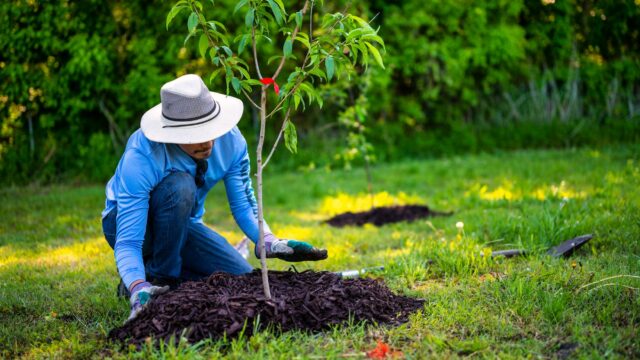
- Mulch the surface. Rain and sprinklers can pound clay into a hard crust. Keep beds covered year-round with 2 to 3 inches of organic mulch, such as shredded leaves, compost or bark.
- Repeat every year. Organic matter gets used up, so the gains fade if you stop. About 1 inch of compost a year maintains a vegetable or flower bed. In perennial and shrub beds, pull back the mulch, spread the compost on top and replace the mulch instead of digging.
Stick to finished compost for anything you dig in. Fresh wood chips, sawdust and similar raw materials can tie up soil nitrogen while they break down, which leaves plants pale and hungry.
Myth check: what doesn’t work
| Claim | Verdict | What actually happens |
|---|---|---|
| Add sand to loosen clay | Usually backfires | Sand can shrink the large pores until clay falls well below 20% of the soil, which is really soil replacement. The wrong mix can set up like low-grade concrete. |
| Gypsum is a clay buster | Only for sodium problems | Gypsum adds calcium and sulfur without changing pH. It helps where excess sodium is sealing the soil, which takes a lab test to confirm. It won’t break up ordinary clay and can raise salt levels. |
| Sulfur breaks up clay | No | Sulfur may lower pH over time if the soil isn’t high in lime. That changes chemistry, not structure. |
| One big load of compost fixes it | No | Additions need to continue at least yearly to keep the improvement. |
| Fill the planting hole with compost | Can drown roots | A pocket of compost in clay holds water that can’t move into the soil around it. Spread 1 to 2 inches over the whole future root zone instead, or skip compost at planting. |
| Till deeply every spring | Short-lived | Freshly tilled soil looks loose but can compact again quickly once it is watered and walked on. |
Colorado State University Extension puts the sand question plainly: put your effort into organic matter instead. The one narrow exception is a small planting of succulents or similar plants, where coarse builder’s sand at 50% or more by volume can improve drainage. Never use fine sand or play sand for this.
Water clay differently
Clay takes water slowly, sometimes as little as 0.01 to 0.5 inch per hour, according to Utah State University Extension. Water that lands faster than that runs off. Apply it at a low rate over a longer time, then let the soil dry somewhat before watering again so air can return to the root zone.
Don’t judge by looks alone. A surface crust can seem dry while the soil just below it is still saturated, so dig down a few inches first.
When raised beds or different plants make more sense
If water sits on the surface for days, you may get faster results by building up. Loosen the ground with a fork, then fill a raised bed with compost and purchased topsoil at a 1:1 or 1:2 ratio. Our comparison of topsoil, garden soil and compost explains what to buy. Roots will still reach into the clay below, and it improves slowly as organic matter and roots work their way down.
Plant choice is the other easy answer. Species that tolerate wet feet, such as river birch and red-osier dogwood, usually do better in heavy soil than plants that demand sharp drainage. Check that anything you choose suits your USDA hardiness zone.
Bottom line
Treat clay as a long project. Test the soil, work it only when it crumbles, mix in 2 to 4 inches of compost at the start, then add about an inch a year and keep it mulched. Leave the sand and the gypsum on the shelf unless a test gives you a specific reason to buy them.
FAQ
How long does it take to improve clay soil?
Where organic matter is low, plan on a few years of steady additions. Digging should get easier as structure improves, but the soil will remain clay, so keep adding organic matter each year.
Can I add play sand to clay soil?
No. Fine sand can reduce pore space and slow drainage further. Only large amounts of coarse sand change drainage, and that is practical only in small specialty plantings.
When is the best time to add compost to clay?
Any time the soil is dry enough to work. Fall is a good choice because the compost has all winter to break down, and you can also use it as a top dressing during the growing season.
Will gypsum hurt my soil?
In most gardens it is more likely a waste of money than a disaster, but gypsum is a salt and can raise salt levels in soils that already have plenty of calcium. Use it only when a lab test confirms a sodium problem.