Do Houseplants Need Grow Lights? How to Decide and What to Choose
Most plants near a bright window don't need help. Here is how to judge your light, when a grow light earns its place, and how the setups differ.
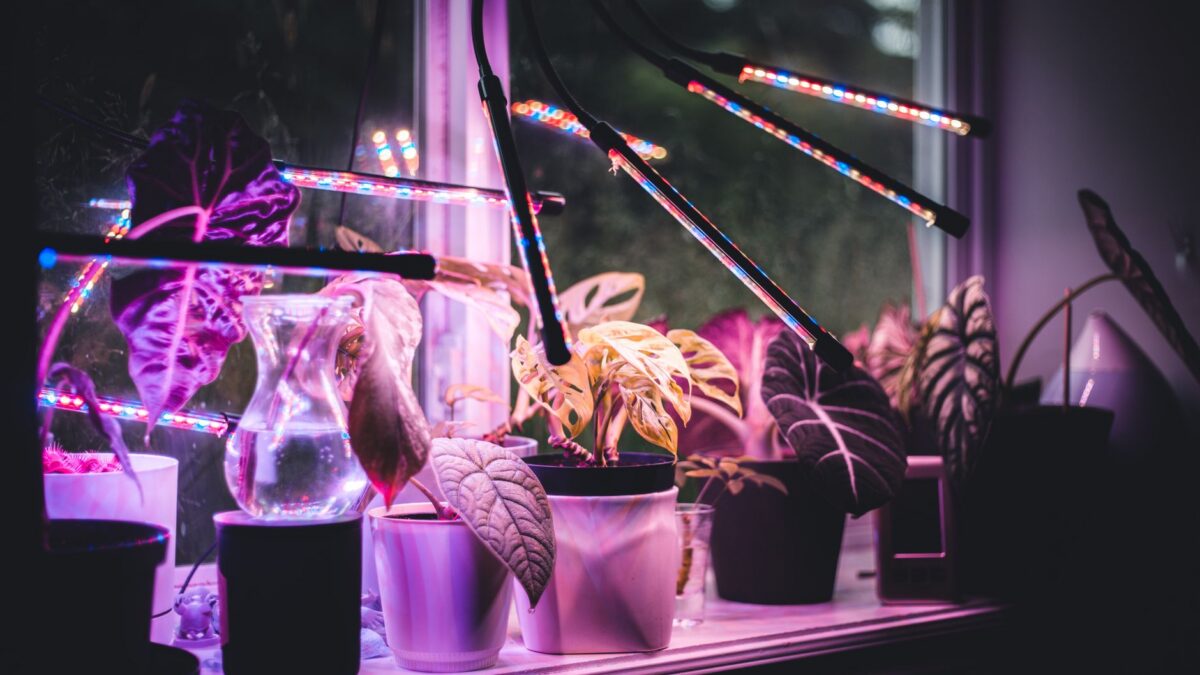
Most houseplants don’t need a grow light if they sit within a few feet of a bright window. You do need one when a plant is farther from the glass, in a north-facing or shaded room, or showing signs of too little light in winter, or when you’re growing high-light plants or flowers indoors. Start by checking how much light your spot really gets. A simple full-spectrum LED on a timer then covers most needs.
University of Illinois Extension calls light the most important factor for getting houseplants through winter, more so than watering or feeding. Light fades quickly as you move away from a window, and our eyes adjust so well that a dim corner can seem bright.
How to judge your window
Start with three simple checks.
- Direction. Iowa State University Extension says south and east windows usually give the most light, west windows can be intense, and north windows suit low-light plants. Trees, buildings, roof overhangs and curtains can change this a lot.
- Distance. Spots more than a few feet from a window are often too dark to grow in, even if they look bright to you.
- Shadow. Hold your hand over the spot around midday. Iowa State describes bright, indirect light as light that casts a distinct shadow without direct sun on the leaves. A faint shadow means lower light.
For a number, use a light meter or a smartphone app at leaf level. Illinois gives these rough estimates for houseplants.
| Light level | About | Typical spot |
|---|---|---|
| Low | 75 foot-candles | North window, or 8 feet or more from a light source |
| Medium | 150 foot-candles | East or west window, or about 5 feet from a south window |
| Bright | 300 foot-candles | South-facing window |
These are guides, not targets. University of Maryland Extension uses a broader scale, and readings change with the season, so test on a winter day if you can.
Decision checklist
A grow light is likely to help if you answer yes to any of these:
- The plant sits more than a few feet from a window, or in a room with no real window.
- New leaves are smaller than old ones, with long gaps between them.
- Stems lean hard toward the glass or look thin and stretched.
- Older leaves yellow and drop, even though your watering is fine.
- A flowering plant won’t bloom, or a variegated plant is fading to plain green.
- You want to grow high-light plants such as succulents, citrus or herbs indoors.
- Winter sets the plant back every year. See our guide to winter leaf drop.
You probably don’t need one if the plant is growing steadily at a bright window, or if it is a low-light plant in a spot that casts a clear shadow. Try moving it closer to the window first. That’s free.
Comparing the setups
The right choice depends on how many plants you have and how much light they need. Treat the distances here as starting points, and let the maker’s instructions override them.
| Setup | Best for | Pros | Trade-offs |
|---|---|---|---|
| Screw-in LED grow bulb | One or two plants, using a lamp you already own | Cheap and simple; fits normal fixtures | Lights a small area; must sit close to the plant |
| LED strip or bar | Shelves, plant stands, under-cabinet spots | Slim and easy to hide; covers a row evenly | Lower output per strip; high-light plants need several |
| LED panel or hanging fixture | Groups of plants, higher-light plants, flowering | More output over a wider area | Bigger and more visible; needs a way to hang it |
| 4-foot LED shop fixture | A shelf of plants or seed trays | Lots of light for the money; Iowa State’s general starting point | Plain look; needs a shelf or chains |
| Fluorescent tubes (T5) | Existing setups, seed starting | Low heat; even light | Must sit closer; replace every 1 to 2 years |
Skip incandescent bulbs. Iowa State says they’re inefficient, run hot, don’t last and put out little usable light.
What the numbers on the box mean
- Distance: Iowa State puts LEDs about 12 to 24 inches from plants and fluorescent tubes 6 to 12 inches away.
- Spectrum: full-spectrum white LEDs look natural and suit most plants. Red and blue grow LEDs work too, but cast a pink or purple glow.
- Lumens vs PPF: lumens measure light as our eyes see it. A PPF figure is the better guide for plants.
- Watts: this tells you the power used, not how much light comes out. Be wary of claims based on watts alone.
How to set one up
- Follow the package on distance and hours. For a generic setup, Iowa State suggests about 14 hours a day.
- For a 4-foot LED shop light, use a full-spectrum daylight fixture of at least 3,000 lumens, hung about 18 inches above the foliage. A fluorescent fixture with two 40-watt T5 high-output tubes goes about 9 inches above.
- Use a timer. Keep total light between 8 and 16 hours a day and let plants have a real dark period. Daily consistency matters.
- Watch the plants for two to four weeks and adjust.
| What you see | What it means | Adjust |
|---|---|---|
| Stretching, spindly growth, leaf drop, yellowing | Too little light | Move closer, add a fixture or use a brighter one |
| Bleached leaves, scorch, unusual reddening, very compact growth | Too much light | Move farther away or remove a fixture |
| Healthy leaves but no flowers | Wrong day length or light color | Change the hours or the light type |
Stretched seedlings follow the same rule, as our guide to leggy seedlings explains. Also remember that some flowering plants need long, unbroken nights. A light left on near a Christmas cactus in fall can stop it from setting buds.
Bottom line
If your plant is near a bright window and growing well, you don’t need a grow light. If it’s stretching, fading or sitting far from the glass, try moving it first. If that isn’t possible, a full-spectrum LED on a 12- to 14-hour timer, placed at the distance on the package, solves most problems. Pick the format by how many plants you have.
FAQ
Can I use a regular LED bulb for houseplants?
It can help low-light plants if it’s bright and close enough, and Iowa State includes full-spectrum daylight LED shop fixtures among its starting setups. High-light plants need much more output than a typical household bulb gives.
How many hours a day should a grow light be on?
Follow the product’s directions. As a general starting point, Iowa State suggests about 14 hours, within a range of 8 to 16 hours.
Can I leave a grow light on all the time?
It isn’t a good idea. Plants need a dark period, and a timer makes that easy.
Do low-light plants need a grow light?
Not usually, if they get some natural light. Low-light means they tolerate dim spots, not that they grow in darkness. In a windowless room, you’ll need artificial light.